
Rideshare Insurance in Chicago: How Coverage Really Works
Afzaal Zeb ·
Driving for Uber or Lyft changes the way your auto insurance works. A personal policy may protect you during normal driving, while the rideshare company's policy may take over during parts of an active trip. The confusing part is the time between those two situations—especially when your app is on and you are waiting for a request.
This guide explains the major coverage periods, the rideshare products advertised by several insurers, and the additional risks involved when a vehicle owner leases a car to another rideshare driver.
Important: This article provides general educational information, not legal advice or an insurance guarantee. Coverage varies by company, policy, vehicle, driver, app, location and claim. Always obtain written confirmation from a licensed Illinois insurance agent before driving or leasing out a vehicle.
Why ordinary personal insurance may not be enough
Personal auto insurance is normally priced for everyday activities such as commuting, shopping and family travel. Carrying passengers for payment creates a different level of risk. Many personal policies therefore limit or exclude coverage when a vehicle is being used for rideshare, delivery or another transportation business.
The Illinois Department of Insurance advises drivers that a personal policy may exclude paid transportation activity. That exclusion can affect liability, collision, comprehensive, medical and uninsured-motorist coverage. A rideshare endorsement is designed to address some of those gaps, but it does not turn every personal policy into unlimited commercial insurance.
The four stages of a rideshare trip
Insurance responsibility depends heavily on the driver's app status when an accident happens.
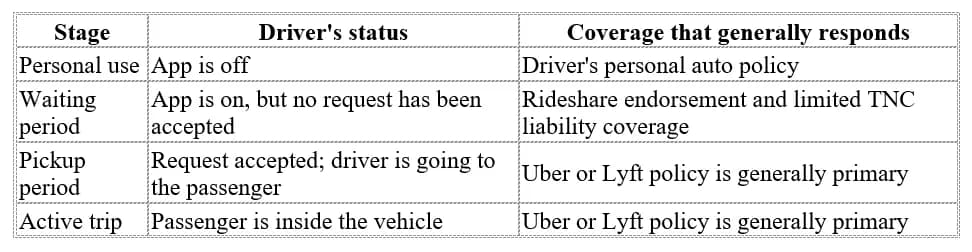
When a driver is online and waiting, Uber and Lyft currently describe third-party liability limits of at least $50,000 per injured person, $100,000 per accident and $25,000 for property damage. This coverage is mainly intended to pay other people when the rideshare driver is responsible. It does not necessarily pay to repair the driver's own car during the waiting period.
After a request is accepted, Uber and Lyft generally provide at least $1 million in third-party liability coverage for a covered accident. Their contingent collision and comprehensive coverage may also repair the driver's vehicle, but only when the driver already carries collision and comprehensive coverage on the personal policy. Both platforms currently describe a $2,500 deductible for this physical-damage coverage.
A simple example
Suppose a driver turns on the Uber app and starts waiting for a request. Before accepting a trip, the driver causes an accident.
Uber's waiting-period liability coverage may pay for injuries or damage suffered by the other party, up to the applicable limits.
Uber generally would not pay to repair the driver's own vehicle during this waiting period.
A properly written rideshare endorsement may extend the driver's personal collision coverage and pay for the driver's car, minus the personal-policy deductible.
That waiting-period protection is one of the main reasons drivers purchase an endorsement.
How rideshare coverage differs by insurance company
The following descriptions summarize the companies' public information. They are not substitutes for the actual Illinois endorsement attached to a policy.
State Farm
State Farm calls its add-on Transportation Network Company Driver Coverage.
During the waiting period, it can extend selected personal coverages, including liability and—when already purchased—collision, comprehensive, medical, rental and emergency-road-service coverage. After a request is accepted, the rideshare company's liability coverage generally becomes primary, while certain State Farm coverages may continue depending on the Illinois policy.
State Farm says the endorsement commonly adds about 15% to 20% to the existing premium, although the actual price depends on the driver, vehicle, location and selected limits. State Farm also states that this personal rideshare product is not intended for Uber Black or other commercial black-car operations.
Ask the agent: Which State Farm coverages continue after a request is accepted, and which deductible applies to damage to your vehicle?
Progressive
Progressive requires a customer to add rideshare coverage when the insured vehicle is used on a rideshare platform.
During the waiting period, the endorsement may extend liability, collision, comprehensive, uninsured-motorist and medical coverage that exists on the personal policy. Once a trip is accepted, the TNC policy generally handles liability and physical damage. Progressive says optional rental reimbursement and roadside benefits may continue during an active trip in qualifying situations.
One notable feature is deductible reimbursement. If the TNC applies a $2,500 collision deductible and the driver's Progressive deductible is $500, the endorsement may reimburse the $2,000 difference on an eligible claim.
Ask the agent: Does the Illinois endorsement include TNC deductible reimbursement, rental coverage and all apps you use?
Allstate
Allstate markets its rideshare endorsement as Ride for Hire.
It is designed to protect the vehicle while the driver is online and waiting for a request. During an accepted trip, the Uber or Lyft policy generally takes the primary role. Depending on the policy, Allstate may also provide additional protection beyond the TNC coverage.
Allstate describes a deductible-gap benefit. For example, if the personal collision deductible is $500 and the rideshare company's deductible is $2,500, the endorsement may pay the $2,000 difference on a covered claim.
Ask the agent: Is Ride for Hire currently available for your Chicago ZIP code, and does the quote include both waiting-period physical damage and deductible-gap protection?
Mercury Insurance
Mercury specifically identifies Illinois as a state where its rideshare product is offered.
The endorsement mainly addresses the waiting period: the app is on, but the driver has not accepted a request. After acceptance and while the passenger is inside, the TNC policy becomes primary. Mercury states that its endorsement does not replace the platform's coverage during those active-trip stages.
Ask the agent: Does the policy cover your own car while waiting, and does it provide any benefit toward the TNC's deductible after acceptance?
American Family Insurance
American Family offers a rideshare add-on to an existing personal auto policy. Its public examples focus on extending selected personal coverage during the waiting period.
If collision, medical payments and property-damage liability are present on the underlying policy, the endorsement may allow those coverages to respond while the driver is online and waiting. Once the driver is matched, the TNC policy generally becomes primary.
American Family's current public information indicates that certain delivery and car-sharing activities may not be included. Passenger rides, food delivery and package delivery should therefore be discussed separately.
Ask the agent: Are Uber, Lyft, Uber Eats, DoorDash and any other apps you use each shown as acceptable uses?
Erie Insurance
Erie advertises rideshare coverage that can protect a driver throughout the rideshare process. However, its public summary does not explain every Illinois-specific limit, deductible or primary-versus-secondary arrangement.
Drivers should ask an Erie agent to identify exactly what happens during the waiting, pickup and passenger stages. The written endorsement—not a general website description—determines how a claim will be handled.
Ask the agent: Which coverages remain active after accepting a ride, and will Erie pay any portion of the TNC deductible?
Farmers Insurance
Farmers' rideshare endorsement is primarily designed to cover the period after the app is activated but before a request is accepted. Farmers states that the endorsement does not cover the period when a rideshare passenger is in the vehicle; the TNC's policy normally handles that stage.
Availability can vary, so a Chicago driver should verify that Farmers is currently issuing the endorsement for the driver's ZIP code, vehicle and apps.
Ask the agent: Is the endorsement available in your area, and does it include collision, comprehensive and delivery activity?
USAA
USAA calls its product Rideshare Gap Protection. It is aimed mainly at protecting an eligible member while the app is on and the driver is waiting for a request. The platform policy generally becomes primary after a ride is accepted.
USAA membership is limited to eligible military members, veterans and qualifying family members. Illinois product availability and app eligibility should be confirmed during the quote.
Ask the agent: Does the endorsement cover both passenger and delivery apps in Illinois, and what happens to physical-damage coverage during each stage?
GEICO and Auto-Owners
Drivers may see these names in online comparison lists, but public information does not clearly establish the same Illinois rideshare product for every applicant. GEICO's Illinois materials refer to rideshare coverage where applicable, while Auto-Owners generally works through independent agents.
Treat both as companies to contact for written verification—not as guaranteed endorsement options. The policy documents should expressly permit the driver's rideshare and delivery activities.
What if you want to lease your car to a rideshare driver?
Leasing your vehicle to another person is different from driving your own insured vehicle for Uber or Lyft. A standard rideshare endorsement should not be assumed to cover this arrangement.
Most of the personal products discussed above are designed around the named policyholder or an approved household driver operating the insured vehicle. When an owner regularly gives a car to an unrelated driver in exchange for weekly or monthly payment, the insurer may view the arrangement as a rental, fleet or commercial transportation exposure.
The Illinois Department of Insurance warns that an owner who rents out a vehicle may remain responsible for accident-related losses, may be denied coverage under a personal policy and could violate policy terms. Simply giving the lessee an insurance card or calling the person a "permitted driver" does not guarantee coverage.
How the listed insurers should be approached
Company
If you plan to lease the vehicle to another driver
State Farm
Do not assume the personal TNC endorsement covers a paid vehicle lease. Ask whether a separate commercial or fleet solution is available. State Farm says its rideshare product does not cover commercial black-car service.
Progressive
Contact a commercial-auto specialist. The personal rideshare endorsement is designed for the insured driver's app use, not automatically for a vehicle-rental business.
Allstate
Do not rely only on Ride for Hire. Ask the business-insurance department whether the owner, lessee and paid rental arrangement can all be scheduled.
Mercury
Its public rideshare description focuses on the insured driver using the car. Obtain written approval for any unrelated lessee or commercial rental arrangement.
American Family
Ask a commercial agent. Its personal rideshare add-on should not be assumed to cover renting or leasing the vehicle to someone else.
Erie
Disclose the complete lease arrangement to an independent Erie agent and request written confirmation of every covered driver and use.
Farmers
Its standard rideshare add-on focuses on the policyholder's waiting-period gap. A separate commercial structure may be necessary for leasing.
USAA
Gap protection is designed for the eligible member's rideshare activity. Do not assume it covers operating a vehicle-rental business.
GEICO
Contact its commercial department and describe the arrangement as a paid lease to a rideshare driver. Do not purchase an ordinary personal policy without written approval.
Auto-Owners
Work with an independent commercial agent and request a policy that expressly lists the owner, vehicle, lessee and TNC use.
First Chicago Insurance
First Chicago specifically states that a vehicle leased from a fleet owner for rideshare or delivery use is written through its Commercial Lines Public Transportation Car Service Program. This is one of the clearest programs to investigate for this situation.
The answer from any insurer can depend on how many vehicles are being leased, whether the owner operates as a business, who holds title, the length of the lease, the driver's record, the apps being used and whether the vehicle carries personal, livery or commercial registration.
Insurance checklist for the vehicle owner
Before handing over the keys, the owner should obtain written confirmation that:
The vehicle is listed by VIN on the correct policy.
The owner or ownership company is the named insured or otherwise has the proper insured interest.
The lessee is listed as an approved or scheduled driver—not merely assumed to have permission.
Paid leasing, rideshare use and any delivery use are expressly permitted.
Liability, collision, comprehensive and uninsured/underinsured-motorist coverage are addressed.
The policy explains who pays each deductible.
The policy identifies coverage during personal use, waiting, pickup and active trips.
Any lender or finance company is correctly listed and has approved commercial use and leasing when required.
The insurer knows whether the vehicle will be used for UberX, UberXL, Comfort, Uber Black, Lyft, delivery or multiple platforms.
The owner knows who reports a claim and what happens to rental income while the vehicle is being repaired.
The owner should also use a written lease addressing payment, mileage, maintenance, tickets, tolls, accidents, deductibles, unauthorized drivers, vehicle recovery and early termination. A lease agreement allocates responsibilities between the parties, but it cannot create insurance coverage that the insurer did not approve.
Insurance checklist for the driver leasing the car
The driver should confirm that:
Their full legal name appears on acceptable insurance documentation.
The vehicle information matches the registration and rideshare account.
The insurer knows the car is leased for rideshare work.
Off-app personal driving is covered, not just active platform trips.
Collision and comprehensive coverage apply to the leased vehicle.
Uber or Lyft accepts the vehicle and documents before the driver goes online.
The rental or lease is not prohibited by the rideshare platform.
Lyft generally directs drivers to use their own car or an approved rental through Express Drive, subject to regional rules. Uber requires current insurance and vehicle documentation and also offers rentals through approved marketplace partners. A private lease found through a marketplace should therefore be verified with the platform before money changes hands.
Uber Black and Chicago livery vehicles are different
A personal rideshare endorsement is generally intended for ordinary TNC driving, such as UberX, UberXL, Comfort or standard Lyft categories. It is not a replacement for commercial passenger-for-hire insurance.
Chicago Uber Black, Black SUV, limousine, taxi and licensed livery operations require commercial insurance that satisfies the applicable city and platform requirements. The owner may also need the correct business structure, vehicle licensing, plates, inspections and chauffeur credentials.
First Chicago Insurance advertises both livery coverage and a commercial car-service program for leased fleet vehicles. Commercial Hirecar Insurance Company is another specialty transportation insurer that may be worth contacting. Availability, underwriting and acceptance by the City of Chicago or a rideshare platform must be confirmed before purchase.
Questions every Chicago driver should ask before buying
Ask each insurer the same questions so the quotes can be compared fairly:
Does this quote include an Illinois rideshare or TNC endorsement?
Does it cover both Uber and Lyft?
Are food and package-delivery apps included?
Is my vehicle covered while I am online and waiting?
Which coverage applies after I accept a request?
Will the policy reduce or reimburse the TNC's $2,500 collision deductible?
Do rental reimbursement and roadside assistance continue during an active trip?
Are there mileage, hours or business-use limits?
If I lease the car to another driver, is the paid lease expressly covered?
Can you send me the endorsement and your answers in writing?
The bottom line
For a Chicago driver using their own car, a rideshare endorsement can close an important gap between personal insurance and the coverage maintained by Uber or Lyft. Progressive and Allstate publicly describe deductible-gap benefits, State Farm may extend several selected personal coverages, and Mercury clearly identifies Illinois as an available state. Other companies may be suitable depending on the driver's ZIP code, vehicle and app usage.
For a vehicle owner leasing a car to someone else, the risk is significantly different. Do not add an unrelated lessee to an ordinary personal policy and assume the arrangement is protected. Disclose the paid lease, rideshare use, all drivers and all platforms, then obtain a commercial, fleet or car-service policy that approves the complete arrangement in writing.
Sources and further reading
Illinois Department of Insurance: Ride-Sharing and Car-Sharing (opens in a new tab)
First Chicago Insurance: Rideshare and Fleet-Leased Vehicles (opens in a new tab)
First Chicago Insurance: Livery Coverage (opens in a new tab)
ChicagoDrivers.com (opens in a new tab) does not sell insurance and is not affiliated with the insurers or rideshare platforms mentioned in this article. Company and product names belong to their respective owners. Information was reviewed in September 2026 and may change.